
Making Tax Digital
The true cost of late tax filing and how to avoid penalties.
ONLY£15A MONTHUnderstand MTD penalty points, late-payment charges and first-year relief, plus practical ways to stay ahead of your tax deadlines.
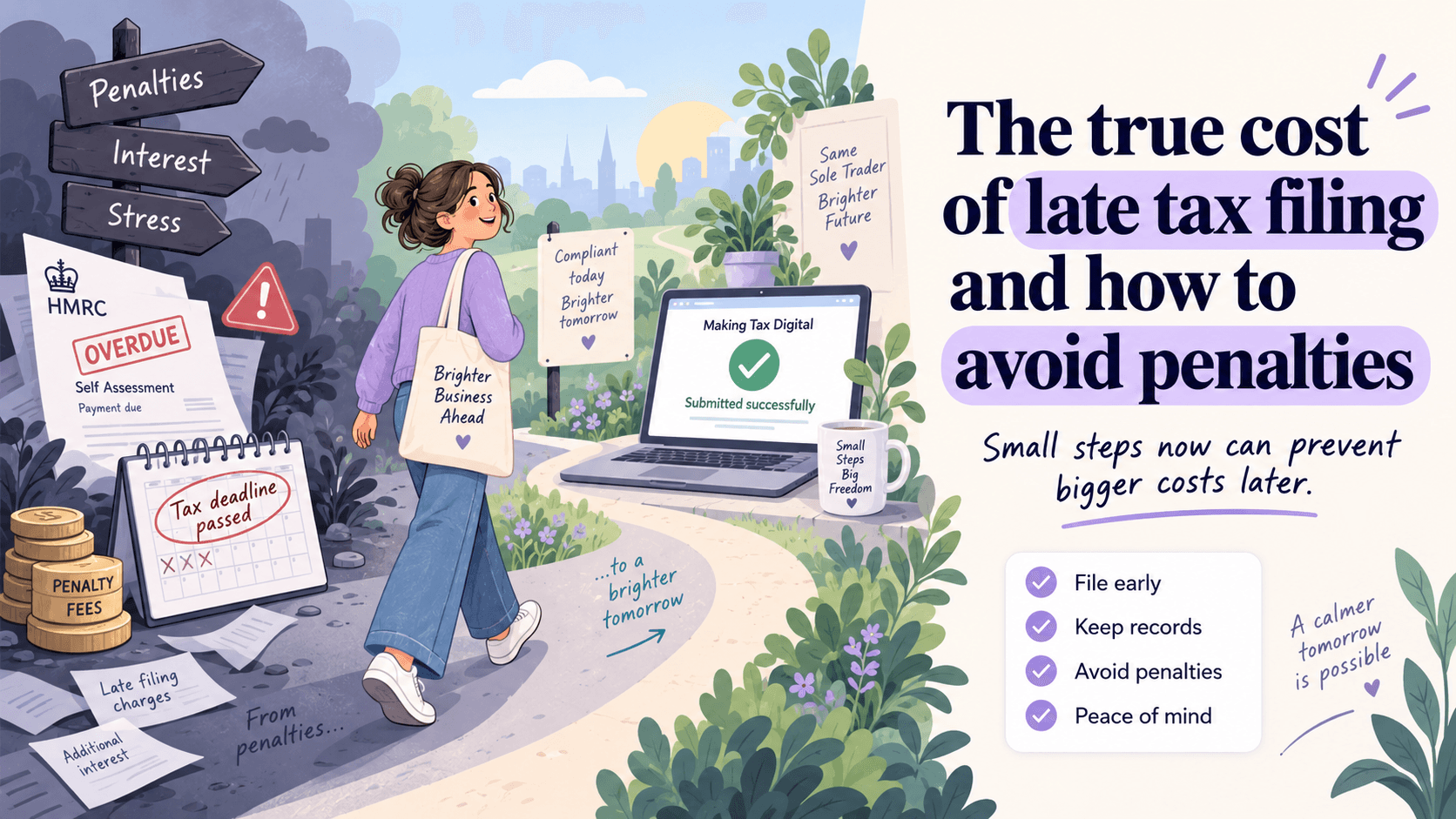
Missing a tax deadline has always been a headache. Under the traditional Self Assessment system, the initial £100 late-filing penalty can be followed by further charges if a return remains outstanding.
Making Tax Digital (MTD) for Income Tax introduces a different approach for those joining the new system: penalty points for missed submission deadlines, alongside separate late-payment penalties.
Here is how the system works and how a regular bookkeeping routine can help you stay on top of it.
How the points-based system works.
Think of it a little like points on a driving licence: repeated missed deadlines can trigger a financial penalty.
- One point per missed deadline: This covers annual returns and, after the 2026–27 exception, quarterly updates. Several late business updates sharing a deadline count as one point.
- The four-point threshold: Reaching four points triggers a £200 penalty. Further missed submission deadlines then trigger another £200 each.
The new regime applies from your MTD joining tax year. Earlier years remain under the previous rules.
Late payment is a separate issue.
Submitting your records and paying your bill are two different responsibilities. Filing on time does not prevent charges if you pay late.
For 2026–27, the standard late-payment schedule is:
- Up to 15 days: No late-payment penalty.
- 16–30 days: 3% of the tax outstanding at day 15.
- 31 days onwards: Another 3% on the day-30 balance, plus a daily penalty at an annualised 10%, for up to two years.
Interest is separate and runs from day one. For 2027–28, the two 3% charges become 4%. First-year relief gives you 30 days to pay or contact HMRC about an agreed payment plan. The relief is available only once.
These late-payment penalties exclude payments on account. See HMRC’s detailed penalty guidance for the full conditions.
The first-year quarterly exception.
No points apply to late quarterly updates for 2026–27, but the updates still need submitting before your annual return. This does not remove annual-return penalties or payment obligations.
Use the breathing space to build a routine. A backlog of uncategorised transactions will still take time to untangle, even when a quarterly penalty does not apply.
How to stay ahead of the deadlines.
The recurring quarterly deadlines are 7 August, 7 November, 7 February and 7 May. Alongside running a business, that is a lot to keep in your head.
- Set reminders early: Put each deadline in your calendar, with time beforehand to review and correct your records.
- Check transactions regularly: A short weekly review is easier than sorting months of receipts in one sitting.
- Include everything: Check cash payments, unconnected accounts and business expenses that your bank feed may not capture.
- Confirm submission: Preparing an update is not the same as sending it. Check the status and keep the confirmation.
- Plan for payment: Keep money aside and contact HMRC early if you cannot pay. Do not wait for a penalty letter to start the conversation.
Make compliance part of your routine.
Avona connects to your bank account to help bring transactions into your bookkeeping, reducing repetitive data entry. You can review categories, check the figures and prepare your MTD updates in the app.
Software can make the process easier, but it cannot guarantee zero penalties. Staying on top of records, submitting successfully and paying on time are what matter.
If your current process feels like a last-minute scramble, talk to us about making it simpler. You can also read our 2026 MTD guide for the wider reporting requirements.